
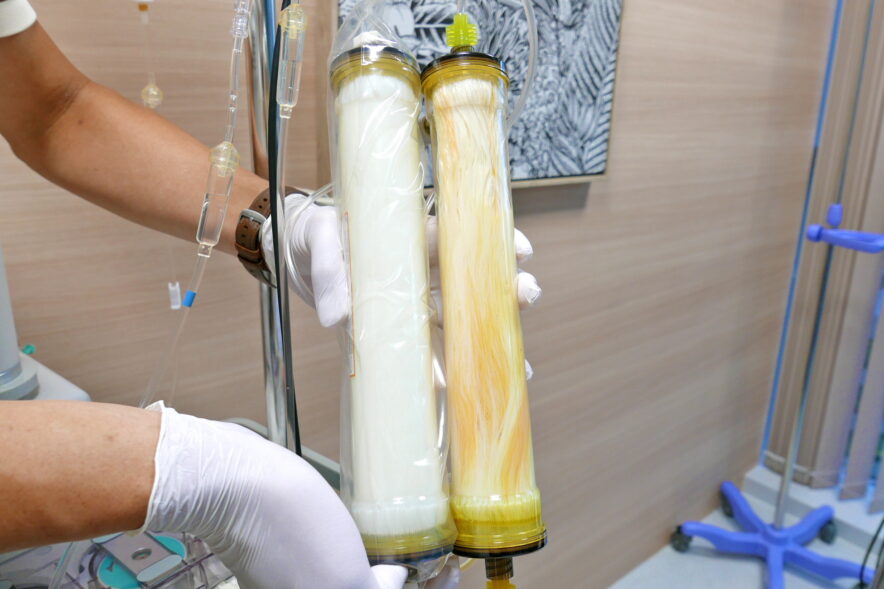
In recent years, interest in apheresis has been growing among people visiting Japanese medical institutions from overseas.
Although it is sometimes referred to by various terms such as "blood purification," "plasma exchange," and "blood exchange," apheresis is by no means a single term that refers to one treatment method.
This is a general term for a series of therapeutic techniques that involve circulating blood outside the body, separating blood cells from plasma, and then removing or adjusting specific proteins, autoantibodies, immune complexes, lipids, and inflammation-related substances present in the blood, according to the desired purpose.
This is already an established field for treating various diseases, including autoimmune diseases, neurological diseases, and dyslipidemia, and organizations such as the American Society for Apheresis (ASFA) have organized the indications and evidence for treatment for each disease.
Currently, this technology is being researched not only in the area of "blood purification for treating diseases," but also in a broader field that studies inflammation associated with aging and the molecular environment in plasma.
However, what's important here is,Not all apheresis is the same.That's the point.
- In apheresis, the key is "what to remove."
- "Selective blood purification" has developed in Japan.
- "Anti-aging" and apheresis
- If you're considering apheresis, what kind of facility should you choose?
- From now on, we'll shift from "blood purification" to "blood profiling."
- For overseas patients, "treatment" is not the only important thing.
- Apheresis is not a "treatment of the future," but rather an "evolving medical technology."
In apheresis, the key is "what to remove."
The common perception is that it involves "passing blood through a machine to remove harmful substances."
However, in reality, blood contains countless proteins, lipids, immune-related substances, and more.
Therefore, it's not simply a matter of "removing a lot of them."
Losing too many essential nutrients can have negative effects on the body.
Therefore, what becomes important is,Which components should be removed, to what extent, and by what method?That's the design.
One of the most common methods is therapeutic plasma exchange (TPE).
By replacing the plasma itself, it is possible to broadly reduce various substances present in the plasma, such as autoantibodies, immune complexes, and inflammation-related substances.
On the other hand, double filtration plasmapheresis (DFPP) is a method that further fractionates plasma and selectively removes specific large molecules by utilizing differences in molecular weight and other factors.
Compared to conventional plasma exchange, this method is characterized by its ability to remove larger molecules while returning some relatively small molecules, such as albumin.
Furthermore, immunoadsorption therapy sometimes utilizes columns that adsorb specific immunoglobulins to perform more selective blood purification.
In other words,
The question isn't "What will be targeted, and by what method will the blood be adjusted?"
This perspective will be important in apheresis going forward.
"Selective blood purification" has developed in Japan.
Japanese apheresis possesses technologies that are unique on a global scale.
While centrifugal separation is the dominant method overseas, membrane separation has been widely used in Japan.
Based on this technological background, selective plasma separation and purification technologies using membranes, such as DFPP, have been developed. The guidelines of the Japanese Society for Apheresis also organize the indications and methods of apheresis in a way that is suitable for clinical practice in Japan.
Recent reviews have also reported that DFPP, as a technology targeting macromolecules such as autoantibodies, immune complexes, and lipoproteins, is being researched and clinically applied in various disease areas.
Furthermore, lipoprotein apheresis, which targets lipids, is also used as a treatment aimed at lowering LDL cholesterol, Lp(a), and other related levels.
In particular, Lp(a) is a lipid-related factor that is strongly influenced by genetics, and the Japanese Society for Apheresis has also compiled information on LDL apheresis, DFPP, and plasma exchange for hyperLp(a)emia.
What we can see from this is that apheresis is not a "treatment that uniformly purifies the blood,"The appropriate method varies depending on the target substance and the patient's condition.That's the point.
"Anti-aging" and apheresis
In recent years, the relationship between apheresis and "aging" has been attracting even more attention.
Aging research is investigating how proteins and inflammation-related factors in the blood may affect various tissues in the body.
In particular, research is progressing that focuses on factors associated with so-called "inflammaging," such as SASP (Senescence-Associated Secretory Phenotype) and inflammatory cytokines, which are secreted in conjunction with cellular senescence.
In 2025, a review was published examining apheresis from the perspective of regulating aging-related factors, and the possibility of regulating inflammatory cytokines and aging-related proteins through TPE and selective apheresis was discussed.
Furthermore, a randomized controlled trial investigating the effects of therapeutic plasmapheresis on biological age-related markers in healthy individuals aged 50 and over was reported in 2025. While improvements were observed in several epigenetic clocks, this is still an area of research, and it should not be considered as proof of "rejuvenation" based solely on these findings.
In fact, in the same year, 2025, another study of healthy individuals reported that no epigenetic rejuvenation effects were observed with a specific plasmapheresis protocol, and that some aging clocks were actually worsened.
These conflicting results are extremely important.
In other words, current apheresis research is,
"You can become younger by exchanging your blood."
It's not that simple.
Rather,
"What bodily functions are affected when certain factors in plasma are adjusted?"
We are still in the process of exploring the possibilities.
Therefore, going forward, apheresis will require not only the treatment itself, but also "assessment" to understand each patient's condition.
If you're considering apheresis, what kind of facility should you choose?
When undergoing apheresis in Japan after coming from overseas, it is not appropriate to choose a facility based solely on price or the newness of its equipment.
There are several points I'd like to confirm.
1. Is there a pre-treatment evaluation?
First and foremost, it's important not to decide on a treatment plan beforehand.
The basic approach involves checking the patient's physical condition as needed, including blood tests, lipid-related markers, inflammation-related indicators, immune-related parameters, liver and kidney function, complete blood count, and coagulation system analysis, and then considering the appropriateness of treatment based on the results.
The goal is not to "receive apheresis,"To medically determine whether it is truly necessary for that person.That's the starting point.
2. Are you recommending only one method?
There are several approaches to apheresis, including plasma exchange, DFPP, immunoadsorption, and LDL apheresis.
Therefore, instead of uniformly offering only one specific method, an environment is desired where methods can be considered according to the patient's test results and objectives.
3. Are specialist staff involved in addition to doctors?
Apheresis is a treatment that utilizes extracorporeal circulation, unlike typical intravenous therapy.
Various factors need to be managed, including vascular access, blood flow rate, anticoagulation, selection of membranes and adsorbents, and circulatory status.
Therefore, it is important to have a multidisciplinary system in place that involves not only medical examinations by doctors, but also clinical engineers and nurses who are proficient in apheresis.
In Japan's apheresis treatment guidelines, apheresis is positioned as a treatment that involves not only physicians but also multiple healthcare professionals, including clinical engineers and nurses.
4. Are you comparing "before treatment" and "after treatment"?
What's even more noteworthy is the comparison of data before and after treatment.
Subjective changes such as feeling "refreshed" or "in good condition" after treatment are not sufficient as a medical evaluation.
What was your condition like before treatment?
Which substances changed, and to what extent?
Is this change temporary, or will it be maintained for a certain period?
By accumulating this kind of information, we can develop apheresis into a more personalized form of medicine.
From now on, we'll shift from "blood purification" to "blood profiling."
When considering the future of apheresis, the "combination of treatment and testing" is particularly interesting.
In recent years, technologies such as proteomics, which analyzes the numerous proteins present in the blood, have advanced significantly.
A large-scale study published in Nature Medicine in 2025 used data from approximately 44,000 people to estimate the biological age of multiple organs from numerous proteins in plasma and to investigate their association with future disease risk.
If this research progresses, in the future,
"This person has high levels of inflammation-related proteins."
"This person has problems with lipid-related factors."
"This person has distinctive immune-related molecules."
In this way, we may be entering an era where we will analyze information in the blood in detail to determine what type of blood purification is most suitable.
In other words,
Examination → Medical evaluation → Appropriate apheresis → Re-examination → Follow-up
That's the cycle.
This is quite different from the simple idea of "purifying the blood."
For overseas patients, "treatment" is not the only important thing.
For patients coming from outside Japan to undergo apheresis, there are yet another challenge.
This includes language, medical history, current medications, past test results, treatment objectives, and follow-up after returning to Japan.
In particular, with regard to apheresis, it is important to consider the patient's overall medical background rather than viewing the procedure in isolation.
Therefore, in the case of overseas patients, instead of simply looking for a facility equipped with an apheresis device,
"A system that organizes pre-treatment medical information, facilitates evaluation by doctors, conducts necessary tests, ensures treatment is received at an appropriate medical institution, records the results, and shares them with the attending physician upon return to Japan."
It is recommended to verify this to the end.
Coming from overseas to receive Japanese medical technology doesn't just mean using the facilities; it also means using the equipment itself.
The value lies in combining apheresis technology, which has been developed in Japan, with medical judgment by specialists, precise examinations, and treatment designs tailored to each individual patient.
Apheresis is not a "treatment of the future," but rather an "evolving medical technology."
Apheresis has already established a strong presence in the treatment of autoimmune diseases and dyslipidemia, while its relationship with aging, chronic inflammation, and plasma proteomes is still an area of ongoing research.
Therefore, it is inappropriate to simply dismiss apheresis as a "rejuvenation treatment."
On the other hand, the ability to physically adjust the molecular environment in the blood presents very interesting possibilities for future preventive medicine and personalized medicine.
What will be important from now on is
What was removed?
Why did you choose that method?
What changed as a result of the treatment?
and,
How can we use these changes to inform future treatments and health management?
That's the perspective.
When choosing apheresis, it's important to select a facility that not only offers blood purification but also understands multiple blood purification technologies, considers treatment methods based on medical evaluations, and can track changes before and after treatment.
That will likely become one of the standards required for apheresis going forward.
Rather than simply "purifying" the blood,We interpret the information obtained from blood and consider the approach that is necessary for that person.
Apheresis is gradually evolving in the direction of such precision medicine.





Comment