
- nanoPDS is a completely new penetration technology.
- Cosmetic ingredients that do not penetrate the skin
- Drug delivery system with controlled absorption through skin and mucous membranes
- PDS (Particle Delivery System) penetrates deep into the skin.
- High molecular weight hyaluronic acid penetrates the skin.
- The future of nanoPDS
nanoPDS is a completely new penetration technology.
"nanoPDS" (Nano Particle Delivery System) is a cutting-edge penetration technology that applies DDS (Drug Delivery System). This technology allows for the effective absorption of high-performance ingredients into the body by nano-encapsulating them, even for high-molecular-weight raw materials that are difficult to absorb through the skin. It is possible to deliver active ingredients directly and rapidly deep into the skin while maintaining the properties of the ingredients without heating. DDS technology maximizes drug efficacy, minimizes side effects, and reduces the burden on patients by precisely controlling the dosage, administration site, and timing of drug administration, and nanoPDS is based on this DDS technology. By encapsulating hydrophilic ingredients with surfactants and dispersing them in oil as tiny particles of several hundred nanometers, skin penetration is greatly improved. Normally, hydrophilic ingredients with large molecular weights cannot pass through the skin barrier, but this technology makes it possible to penetrate into the skin. Research has shown that proteins and other substances that penetrate into the skin maintain their activity and function properly while maintaining their properties. nanoPDS enables the transdermal absorption of high-molecular-weight and unstable ingredients such as vitamin C and hyaluronic acid, and is being applied to cosmetic development. In the future, it is expected that this technology will be applied to a wide variety of ingredients beyond those found in cosmetics.
Cosmetic ingredients that do not penetrate the skin
Cosmetic ingredients are generally considered to have difficulty penetrating the skin. This is because the molecular weight of the ingredients is too large to pass through the skin's barrier. It is said that only ingredients with a molecular weight of 500 or less can penetrate healthy skin. Molecular weight is the sum of the atomic weights; in the case of water, H=1.010 + O=16.0 = 18.0. Therefore, water can pass through the skin. The reason your fingers become wrinkled after soaking in the bath for a long time is because water molecules have penetrated your skin.
Hyaluronic acid, a well-known beauty ingredient, has a molecular weight of approximately 1 million, and collagen has a molecular weight of approximately 300,000. Under normal circumstances, these ingredients do not penetrate the skin. However, ingredients that possess both lipid-soluble and water-soluble properties have higher skin penetration. This is because the stratum corneum easily absorbs lipid-soluble ingredients, while the lower layers easily absorb water-soluble ingredients. Removing the stratum corneum increases absorption, but since the stratum corneum also has a barrier function, frequent removal can irritate the skin and cause problems.
Drug delivery system with controlled absorption through skin and mucous membranes
Drug delivery systems (DDS) are systems that control the movement of drugs within the body, enhancing drug efficacy, reducing side effects, and improving patients' quality of life (QOL). Because it is difficult to incorporate all the necessary properties such as efficacy, safety, stability, absorption, duration of action, and targeting into the structure of a drug, DDS technology has recently been attracting attention for new substances such as peptides, proteins, DNA, and RNA.
Drug delivery system (DDS) technology has three core technologies: (1) targeting (target-oriented DDS), (2) release control (release-controlled DDS), and (3) barrier penetration and absorption enhancement (absorption-controlled DDS). Targeting is a technology that concentrates drug delivery to the lesion site and is classified into passive and active targeting. Release control is a technology that controls the timing of drug dissolution after administration. Barrier penetration and absorption enhancement is a technology that improves drug absorption through the skin and mucous membranes, and "nanoPDS ultra-skin penetration technology" is a groundbreaking technology that achieves this barrier penetration and absorption enhancement.
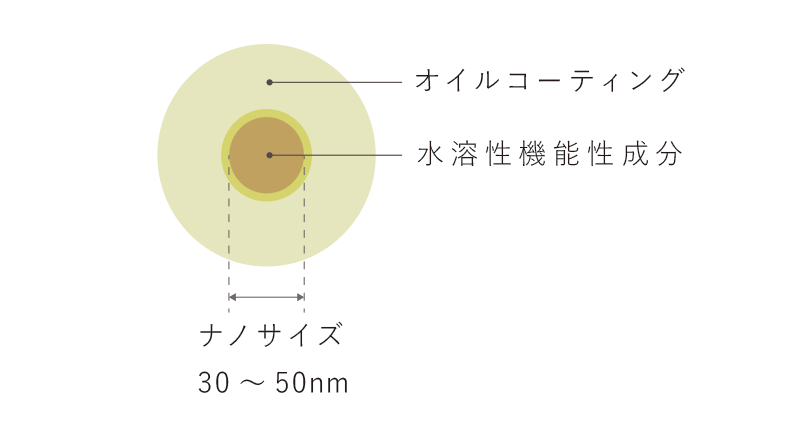
PDS (Particle Delivery System) penetrates deep into the skin.
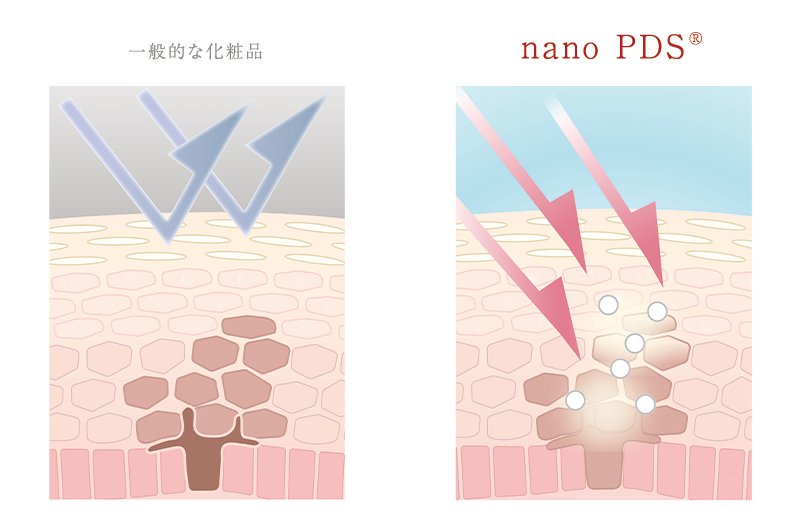
By rapidly stirring, water-soluble drugs and oil-soluble surfactants are mixed to create a stable WO-type emulsion, and then the water is removed to produce nanoPDS. This technology makes it possible to rapidly deliver high concentrations and large quantities of substances deep into the skin. Conventionally, it was believed that components with a molecular weight of 500 or more could not reach the dermis, but nanoPDS technology allows high molecular weight raw materials with molecular weights of 5 to 2 million to be absorbed into the skin. For example, by nano-coating hyaluronic acid, it can penetrate the skin, allowing drugs to be delivered deep into the skin.
High molecular weight hyaluronic acid penetrates the skin.
Studies have shown that when hyaluronic acid is dispersed in an oily base using PDS technology, approximately 3.6 times more hyaluronic acid penetrates the skin compared to regular water-soluble hyaluronic acid. This is because the hyaluronic acid can easily pass through the hydrophobic stratum corneum and be transported to the epidermis and dermis. Microscopic observation of a cross-section of the skin confirmed that the hyaluronic acid had penetrated sufficiently. On the other hand, with regular water-soluble hyaluronic acid, while fluorescence is observed in the stratum corneum, it is very weak in other tissues, indicating that very little penetrates deep into the skin.

The future of nanoPDS
nanoPDS technology boasts high versatility and is expected to have applications not only in the cosmetics field but also in various other fields such as pharmaceuticals and food. In the pharmaceutical field, drugs that previously had to be administered by injection can now be absorbed through the skin and used for treatment. Furthermore, drugs that were previously difficult to administer to children and the elderly can now be absorbed through the skin, reducing the burden on the patient and allowing for their use in a wider range of treatments.
In the food sector, it is expected that processing water-insoluble nutrients and fat-soluble vitamins so that they can be absorbed through the skin will enable more efficient nutrient supplementation. This is thought to enable a healthier lifestyle for people who cannot obtain sufficient nutrients through their diet, such as the elderly and those who are ill.
In the future, further advancements in nanoPDS technology are expected to enable more efficient absorption. This technology is also anticipated to lead to the development and application of new polymer compounds. It is expected that nanoPDS technology will contribute to many people in the medical and food sectors.





Comment