
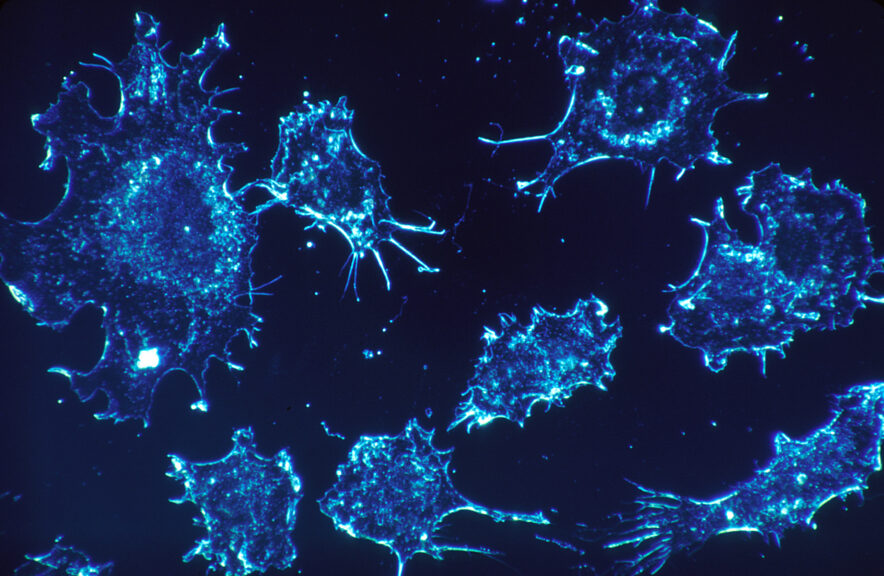
Why do people grow old?
One of the answers to that question is now becoming clear.
It's the "accumulation of senescent cells."
Our bodies are maintained by the constant renewal of a vast number of cells every day.
However, during this process, cells are created that stop dividing and lose their original function.
Those are called "senescent cells."
- "Zombie cells" silently eat away at the body.“
- A shift in perspective: "Remove" rather than "cure"
- The reality of "rejuvenation" as revealed by experiments
- How far has its application to humans progressed?
- Aging is a "bug that accumulates."
- From medical care to "optimization"
- Will the concept of lifespan collapse?
- The revolution has already begun
"Zombie cells" silently eat away at the body.“
Senescent cells are not simply useless.
What's more troublesome is that their presence has a negative impact on those around them.
These cells secrete inflammatory substances that interfere with the function of normal cells.
Furthermore, it can lead to a decline in the overall functionality of the organization.
It's like a zombie silently rotting away at its surroundings.
As we age, these aging cells accumulate in the body.
And that can trigger chronic diseases and a decline in physical function.
A shift in perspective: "Remove" rather than "cure"
This is where the concept of "senolytics" comes in.
This is a technology that selectively removes only senescent cells.
Traditional medicine has tried to "treat" tissues that have lost their function.
But senoristics is different.
Delete unnecessary items.
This will restore overall performance.
It's an extremely simple, yet revolutionary approach.
The reality of "rejuvenation" as revealed by experiments
The reason this field is attracting attention is clear.
Remarkable results have already been reported in animal experiments.
Mice from which senescent cells were removed not only had their lifespan extended, but also...
Muscle strength recovery, improved cognitive function, and even a rejuvenation of the coat were observed.
In other words, it's not just about prolonging life,
“A "recovery to a youthful state" is occurring.
This represents a major turning point in the history of medicine.
How far has its application to humans progressed?
Currently, senolistics is already in the clinical research stage.
Certain drugs and compounds have been shown to potentially selectively kill senescent cells.
Some of these are combinations of existing drugs, so the hurdles to practical application are not particularly high.
However, there are also challenges.
Senescent cells are not entirely "evil."
It can sometimes play a temporarily beneficial role, such as in wound healing or cancer suppression.
In other words, simply removing it isn't the solution.
At what point and to what extent should it be removed?
That "control" will be the key to the future.
Aging is a "bug that accumulates."
What if aging cells were "bugs" accumulating in the body?
Senolytics is like a patch to remove that bug.
From this perspective, aging is not an unavoidable phenomenon.
It transforms into a manageable process.
In other words, the human body is
“This means it will become a "maintainable system."
From medical care to "optimization"
Imagine a future where cenortics is widespread.
Once you reach a certain age, remove senescent cells regularly.
Maintain physical performance.
That is no longer a treatment.
It's a physical upgrade.
This change will redefine the very definition of medicine.
The era of going to the hospital only after becoming ill is over.
From now on, it's time to manage and optimize aging.
Will the concept of lifespan collapse?
If we can control senescent cells,
What will happen to human lifespan?
It's not simply about extending.
The very concept of "aging" may become ambiguous.
Even as you age, your body remains young.
If that situation becomes a reality, it will change your entire life plan.
Work styles, learning styles, family structures.
Everything will be redefined.
The revolution has already begun
Senolytics is not yet widely known to the general public.
However, progress is definitely being made on the front lines of medical care.
Quietly, but surely.
Aging is no longer something that is "unavoidable".
“It is gradually becoming a target that can be intervened in.
And beyond that lies...
This is an update to the very nature of humanity.






Comment