
How much can the body change if you change your blood?
Aging doesn't begin with the skin. The essence of it runs much deeper. The key lies in the inside of the blood vessels, the quality of the blood, and the environment surrounding the cells. Our bodies are sustained by approximately 5 liters of blood, which constantly circulates essential elements for life such as oxygen, nutrients, hormones, and immune cells. But what if that blood were accumulating substances that cause chronic inflammation, lipids that cause arteriosclerosis, and proteins that accelerate aging? No matter how high-quality the supplements you take, or how advanced the cosmetic medical treatments you receive, there are limits to rejuvenation at the cellular level unless the "circulating blood itself" is in good condition. This is where blood purification therapy, based on the idea of directly improving the blood itself, comes in.
What is blood purification therapy? – Medical background
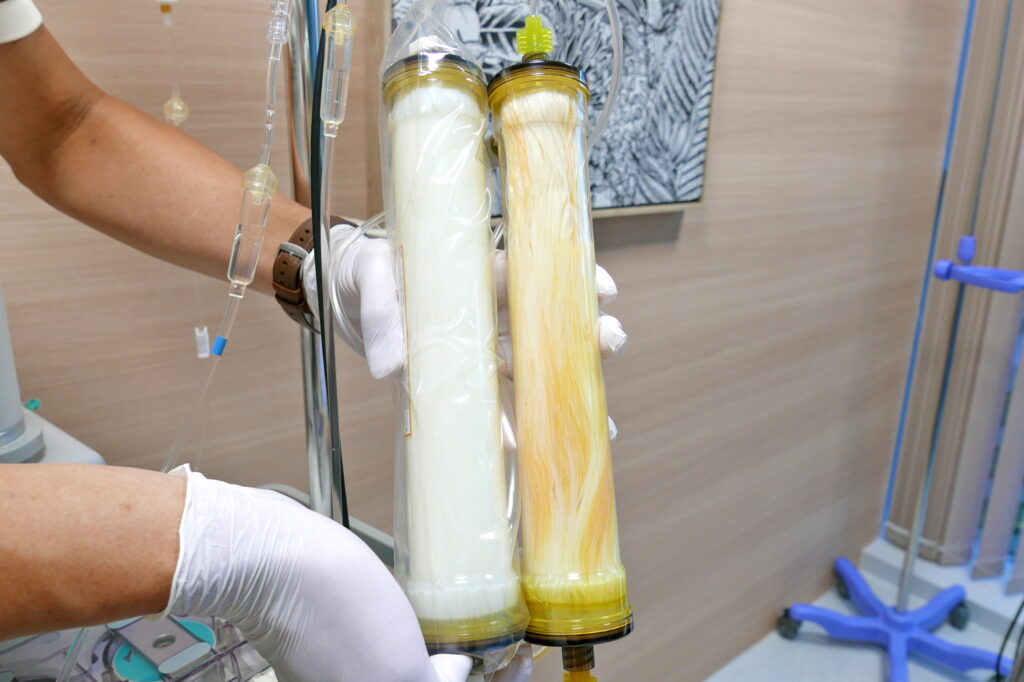
Blood purification therapy is a medical technique that involves removing blood from the body, using a special filter to remove unwanted substances, and then returning the purified blood to the body. Medically, it is classified as apheresis therapy or double filtration plasmapheresis (DFPP), and originally developed for the treatment of autoimmune diseases, neurological diseases, severe dyslipidemia, and collagen diseases. In other words, it is not a technique that originated as cosmetic medicine, but a medical technique established to protect lives, and its safety management and techniques are backed by many years of clinical experience. In recent years, its application in preventive medicine and anti-aging through the reduction of chronic inflammation and improvement of vascular function has attracted attention.
What exactly will be removed?
The essence of blood purification therapy lies in "selective removal." Its characteristic feature is that it doesn't remove everything in the blood, but rather targets and separates pathological or excessive components. Typical components targeted for removal are as follows:
1. LDL cholesterol (bad cholesterol)
The main cause of arteriosclerosis. It deposits on the blood vessel walls and causes plaque formation.
2. Neutral fat
Factors that increase blood viscosity and worsen blood flow.
3. Inflammatory cytokines
A molecule that maintains chronic inflammation. It is also considered a factor that accelerates aging.
4. Autoantibodies
Antibodies that cause autoimmune diseases.
5. Aging-related secretory factors (SASPs)
Inflammatory substances released by senescent cells.
By physically removing these substances, it becomes possible to bring the blood environment back to a state close to a "reset." This is significantly different from metabolic regulation through oral medications or supplements, as it directly approaches the circulatory environment itself.
The relationship between blood vessels and aging
It is said that aging begins in the blood vessels. Endothelial cells are extremely delicate, and when exposed to inflammation and oxidative stress, their function declines, impairing their ability to regulate blood flow. When endothelial function declines, a chain reaction occurs: blood flow worsens, blood pressure rises, the risk of blood clots increases, and oxygen supply to organs decreases. This is not merely a circulatory system problem, but also affects brain function, muscle strength, and immune function. Blood purification therapy is an approach that aims to reduce the burden on endothelium and improve the blood flow environment by removing inflammatory substances and lipids from the blood, and as a result, it may improve the foundation for overall metabolic efficiency and energy supply.
Treatment process and safety
The procedure typically takes about 2 to 3 hours. Blood is drawn from both arms, filtered and purified using a specialized device, and then returned to the body while retaining essential components. Although circulating blood volume is constantly monitored and no sudden fluctuations occur, as with any medical procedure, certain risks exist, such as fluctuations in blood pressure, internal bleeding at the puncture site, and changes in electrolyte balance. Therefore, it is essential that the procedure be performed under appropriate judgment and strict supervision by a physician. A major characteristic of this treatment is that it directly intervenes in blood, the foundation of life, while ensuring safety.
The boundary with doping
This raises the ethical aspects of manipulating blood. In the world of sports, blood manipulation is strictly restricted as doping, but in the medical world, it is performed for life support and disease treatment. If the purpose is to improve athletic performance, it is viewed as problematic, but if it is for health recovery or prevention, it is recognized as medical treatment. This boundary is very delicate, and the evaluation changes depending on whether aging is considered a natural phenomenon or a functional decline that should be prevented. Blood purification therapy is not aimed at enhancing performance, but is a medical approach that rebuilds the foundation of health by improving the circulatory environment.
Aging is a cyclical problem.
Aging is not simply the passage of time; it is a decline in the quality of circulation. When blood flow is stagnant, cells deteriorate, and when inflammation persists, tissues age. Blood purification therapy is a strategy to regulate the circulation flowing through the body's core, aiming for redesign at the vascular level rather than just superficial rejuvenation. It is not a medical treatment that exaggerates dramatic changes, but it can be said to be an extremely fundamental approach.
To what extent can humanity control its blood?
From a time when even blood transfusions were life-threatening, humanity has acquired the technology to separate, selectively purify, and recirculate blood. The next era will be one of precisely removing only aging factors, or perhaps replenishing rejuvenation factors. Blood is not merely a bodily fluid; it is information, energy, and the infrastructure of life. The fight against aging is not a fight against time, but a fight against circulation. Choosing to improve blood circulation is a quiet but strategic step in rebuilding the very foundation of the body.
[Related Articles]




Comment